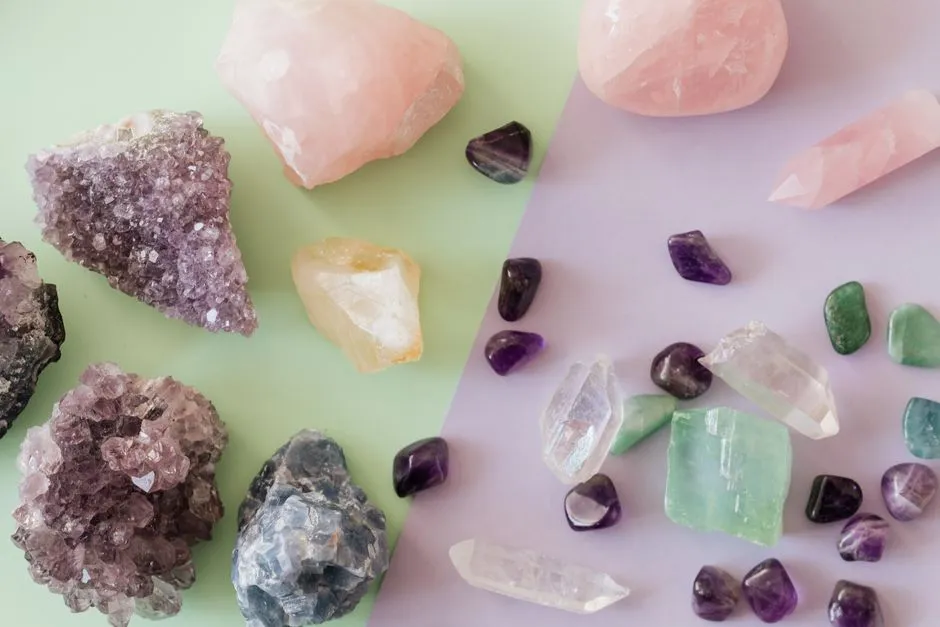
The crystal market has a counterfeit problem. Demand has outrun supply for several popular stones, and the gap has been filled with dyed, heat-treated, and reconstituted material sold under premium names. Most of it is not malicious; some of it is. Either way, knowing what you are actually buying is part of being a thoughtful collector.
This is a working field guide, not a gemological one. The cues here are the ones experienced buyers use at markets and online.
The most-faked stones
Citrine. Most "citrine" sold today is heat-treated amethyst. Real citrine is rare; it forms naturally as a pale lemon-yellow to smoky-gold quartz, often with a subtle smoky tail at the base. Heat-treated material is a much darker burnt-orange, often with white tips, and frequently shaped as a geode "cathedral." Both are real quartz; only one is real citrine. Ask before you buy.
Turquoise. Genuine turquoise is expensive and increasingly mined out. The most common substitute is dyed howlite or magnesite, which have the right color but not the matrix pattern. Real turquoise has a brown or black "spider web" matrix that follows the original mineral structure, not stamped or painted on. Dyed howlite scratches white under the surface; genuine turquoise does not.
Moldavite. A meteoric tektite, naturally green, with a distinctive ridged surface. Most "moldavite" online is moulded green glass. Real moldavite is light for its size, has irregular pitted surfaces, and never comes in identical pairs. If two pieces look the same, both are fake.
Lapis lazuli. Real lapis is a deep blue with golden flecks of pyrite. Fakes are often dyed howlite or sodalite, uniform color, no pyrite, sometimes a chalky look at the edges. A small drop of acetone on a hidden spot will lift the dye on a fake; it will not affect real lapis.
Malachite. Reconstituted malachite (powder + resin) is widespread. Real malachite is heavier than it looks, cool to the touch, and has banding that flows in unpredictable concentric rings. Reconstituted material has a uniform grain and can feel suspiciously light.
Amethyst clusters. Cheap amethyst clusters are sometimes deeply dyed quartz. Real amethyst color is strongest at the tips and lighter at the base; dyed material is uniform throughout, and the color may rub off slightly on a wet white cloth.
"Cherry quartz," "blue obsidian," "opalite." These are all glass, not stone. Sometimes pretty, but not crystals. Reputable sellers will say so.
Cues that the seller is honest
- They use scientific or trade names ("heat-treated amethyst" rather than "citrine") without prompting.
- They state country of origin and, ideally, the mine.
- They distinguish between natural, treated, reconstituted, and synthetic.
- They will not sell you "moldavite" for $12.
- They are willing to write what you are buying on the receipt.
Cues that you should walk away
- Identical "natural" specimens stacked in a tray.
- Impossible saturation of color, especially in clusters.
- "Genuine moldavite" at any price below several hundred dollars.
- "Real turquoise" with no matrix and a perfectly uniform color.
- Sellers who will not name a country of origin.
Buying online
Buy from sellers who post real, well-lit, high-resolution photos of the actual piece you will receive, not stock images. Read reviews carefully, especially negative ones. Pay attention to size; "amethyst cluster" can mean a five-pound centerpiece or a thumb-sized chip. Always check the listed weight or dimensions.
When in doubt, buy in person. Markets and rock shops are where the eye is trained. Ask the seller to tell you about the stone. If they can answer with specifics, where it came from, how it was treated, what the matrix tells you about how it formed, you are usually in good hands.
A final note on price
A real, ethically-sourced, untreated specimen of a desirable stone is going to cost what it costs. If a price seems too good to be true, it is reflecting one of three things: a fake, a treated stone sold as natural, or labor that was not paid fairly. Knowing which one is part of being a collector.