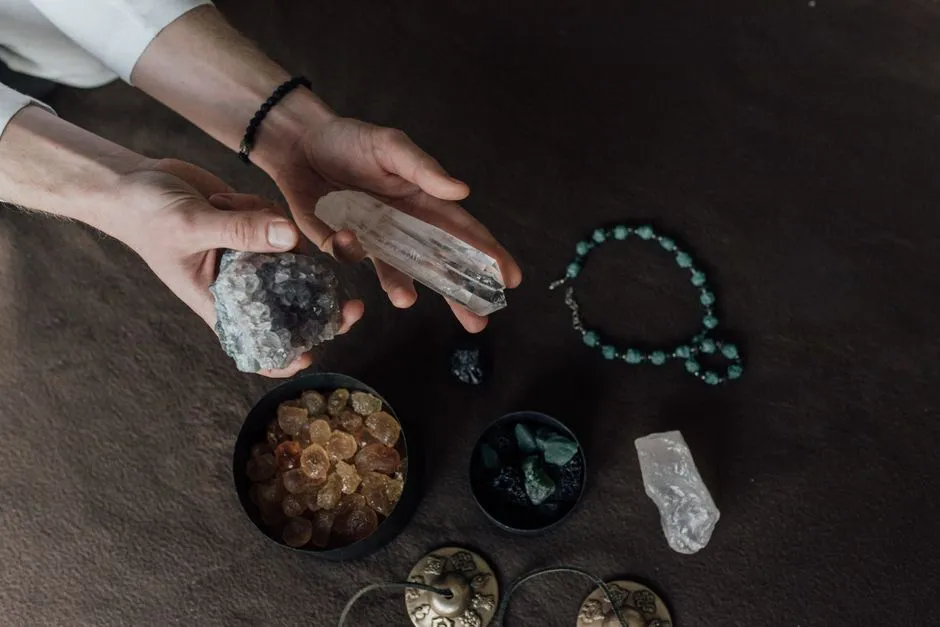
There are two honest reasons people come to crystals. The first is that something hurts and ordinary tools have not touched it. The second is that something inside is asking to be paid attention to, and a beautiful object held in the hand is a low-friction way to listen. Both reasons are good. Neither requires you to believe a particular story about how the stones "work."
This guide assumes you are a thoughtful person who is curious. We will skip the marketing and walk through what a small, useful practice actually looks like.
What crystal healing is, in plain language
Crystal healing is a contemplative practice. You hold or place a stone, you direct attention to a part of your life or body, and you let the stone act as a focal object, the same role a candle plays for a meditator or a rosary plays for someone praying. Different stones are traditionally associated with different qualities (calm, courage, clarity), and those associations come from centuries of folk knowledge, color symbolism, and lived experience. They are not laboratory measurements, and you do not need them to be.
What the stone is, materially, is also true. Amethyst really is a violet variety of quartz that grew slowly inside a pocket of cooled volcanic rock. That fact, on its own, is worth ten minutes of attention.
The five stones that earn their keep
You do not need a hundred crystals. You need five that you actually use.
- Clear quartz, the all-purpose stone. Use it whenever you do not know which stone to use. It is the white t-shirt of the crystal world.
- Amethyst, for sleep, mental noise, and overthinking. Keep it on the nightstand.
- Rose quartz, for the heart, in every meaning of that word. Self-talk, grief, big love, small disappointments.
- Black tourmaline or obsidian, for grounding and protection. Keep it where energy enters: the front door, the office, the phone.
- Citrine or tiger\'s eye, for confidence, agency, and getting unstuck. Carry it on days you have a hard conversation or a hard task.
This is enough. You can build a beautiful, useful practice on these five.
How to actually use them
The most common mistake is treating crystals like supplements, buy it, swallow the idea, hope it works. Crystals respond to attention. If you do not give them any, they will sit on a shelf and look pretty, which is also fine.
A working practice usually has three parts:
- Set an intention out loud. Not a wish. A direction. "I am working with this stone this week to listen to my body before answering yes."
- Put the stone where you will see it. Pocket, desk, bedside table, bathroom mirror. The visual reminder does most of the work.
- Touch it. When you remember the intention, pick it up. Thirty seconds is enough.
Repeat for a week. Notice what shifts. Most people are surprised by how unmagical and how effective this is.
Cleansing and care
Stones pick up dust and, in many traditions, energetic residue. Both are real in the sense that both deserve cleaning. Once a week or after a heavy day:
- Run the stone under cool water (skip this for selenite, halite, malachite, or anything porous).
- Set it on a windowsill in moonlight overnight.
- Leave it on a bed of dry sea salt or in a bowl with a piece of selenite.
Pick one. Do not overthink it. The cleansing is half ritual, half hygiene, and both halves are worth doing.
What this practice is not
Crystals are not a substitute for therapy, medical care, or a hard conversation you have been avoiding. The most reliable use of a stone is as a small, beautiful nudge toward the action you already know you need to take. If your practice ever starts to feel like avoidance dressed up in spiritual language, put the stones down for a week. They will still be there.
The point of crystal lore is not the lore. It is the slowing-down, the attention, and the recovered habit of noticing your own life. The stones are excellent at being a doorway for that. That is not a small thing.