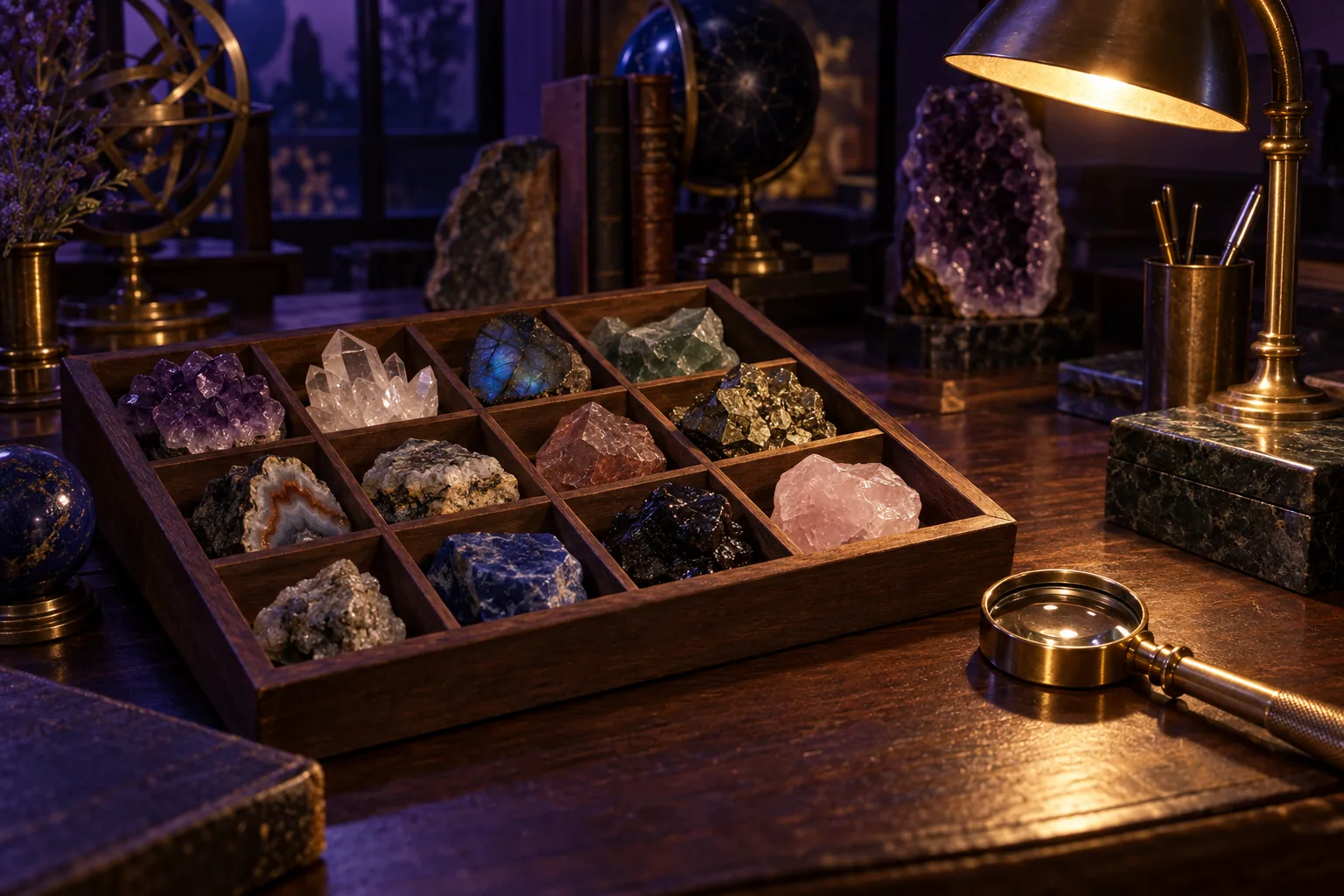
Properties
| Category | Tectosilicate minerals |
|---|---|
| Formula | SiO; 2 (silica) |
| Crystal system | Trigonal (quartz) or monoclinic (moganite) |
| Color | Various |
| Crystal habit | Various |
| Cleavage | Absent |
| Fracture | Uneven, splintery, conchoidal |
| Mohs scale hardness | 6–7 |
| Luster | Waxy, vitreous, dull, greasy, silky |
| Streak | White |
| Diaphaneity | Translucent |
| Specific gravity | 2.59–2.61 |
From the Wikipedia article
Chalcedony is an aggregate of cryptocrystalline or microcrystalline silica, or in simpler terms, a mass of individual silica crystals that are too small to be seen without magnification. It is composed primarily of quartz, with minor amounts of intergrown moganite. These are both silica minerals with a chemical composition of SiO2, but they differ in that quartz has a more symmetrical crystal structure (trigonal) than moganite (monoclinic). Mineralogically speaking, the quartz and moganite crystals in chalcedony must grow in parallel chains, called "fibers." However, the term chalcedony may more broadly refer to any microcrystalline or cryptocrystalline silica, fibrous or not.
Source
Source record: crystal-compendium/chalcedony/minerals.json. Fetched from English Wikipedia by the operator 2 October 2026.
https://en.wikipedia.org/wiki/Chalcedony — revision id 1372143626. Text and properties from Wikipedia, licensed CC BY-SA 4.0.