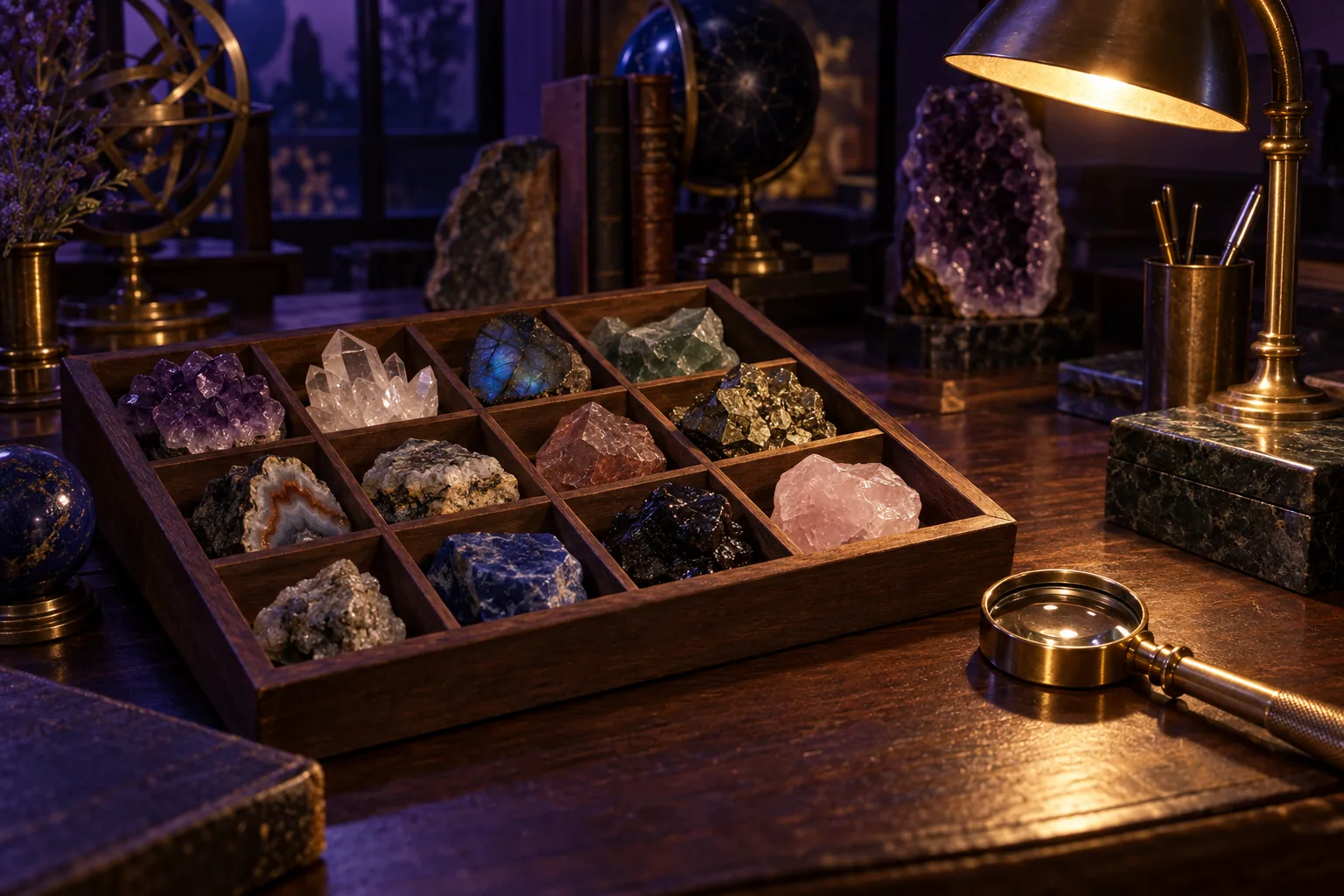
Properties
| Category | Tectosilicate minerals |
|---|---|
| Formula | SiO2 (silicon dioxide) |
| Crystal system | Trigonal (quartz) or monoclinic (moganite) |
| Color | Often multicolored; commonly colorless, pale blue to black, red to orange, yellow, white, brown, pink, purple; rarely green |
| Crystal habit | Cryptocrystalline silica |
| Cleavage | None |
| Fracture | Conchoidal |
| Tenacity | Brittle |
| Mohs scale hardness | 6.5–7 |
| Luster | Waxy, vitreous when polished |
| Streak | White |
| Diaphaneity | Transparent to opaque (usually translucent) |
| Specific gravity | 2.60–2.64 |
| Density | 2.6 g/cm3 |
From the Wikipedia article
Agate is a banded variety of fibrous chalcedony. Agate stones are characterized by alternating bands of different colored chalcedony and often contain some visible quartz crystals. They are common in nature and can be found globally in a large number of different varieties. Most agates are concentrically banded, while some have bands that form parallel lines. Certain varieties of chalcedony without bands are commonly called agate, but these are not true agates. Moreover, not every banded chalcedony is an agate.
Source
Source record: crystal-compendium/agate/minerals.json. Fetched from English Wikipedia by the operator 2 October 2026.
https://en.wikipedia.org/wiki/Agate — revision id 1371907988. Text and properties from Wikipedia, licensed CC BY-SA 4.0.